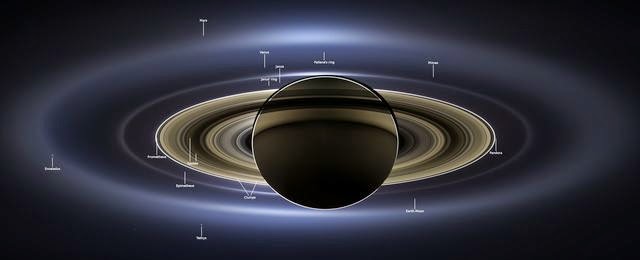
NASA released the first color image of Saturn, which can be seen its moons, rings, as well as Earth, Venus and Mars. New panoramic mosaic of images from the Cassini spacecraft shows a view that could see the man. Was presented on Tuesday at the Newseum in Washington.
Photography is a combination of 141 wide-angle photos taken by four hours on 19 July 2013. This includes almost 652,000 km of Saturn's neighborhood until the E ring - the second most outer ring of the gas giant. Carolyn Porco, imaging team leader at the Cassini Space Science Institute, says that "on this one great picture, Cassini has shown us the wonders of the world."
Mosaic was created in the framework of the campaign " Wave Saturn " ( " Wave at Saturn" ) , under which NASA in advance invited people around the world to July 19 looked at the night sky and shared a common greeting photographs of Saturn.
Picture can be seen in ordinary version and signatures . Earth is visible as a blue dot on the bottom right of Saturn. Venus, as the bright spot at the top left of Saturn. At the top left of Venus tiny point appears to Mars . The picture is also included seven moons , including Enceladus , and 809 stars.
Attention glow ring E. Because the ring is thin , it is best visible when illuminated from the opposite direction . Small particles of dust and ice then scatter the light by diffraction. Mosaic contains a large amount of information about the rings and their structure . By analyzing these images for the first time observed the tiny moons Anthe and Methone .
Cassini does not take often attempts to take pictures of the Earth , because from the perspective of the probe our planet is usually so close to the Sun , and photographing it could damage the optics of the ship. Therefore, service Cassini was looking for opportunity when the point of view of Cassini Sun is hidden behind Saturn . Such an opportunity presented itself precisely on July 19 .
The picture is taken at an angle of seventeen degrees to the plane of the rings. Cassini was then at a distance of approximately 1.2 million kilometers from Saturn. Resolution on the surface of Saturn is about 72 km per pixel.

Brak komentarzy:
Prześlij komentarz